

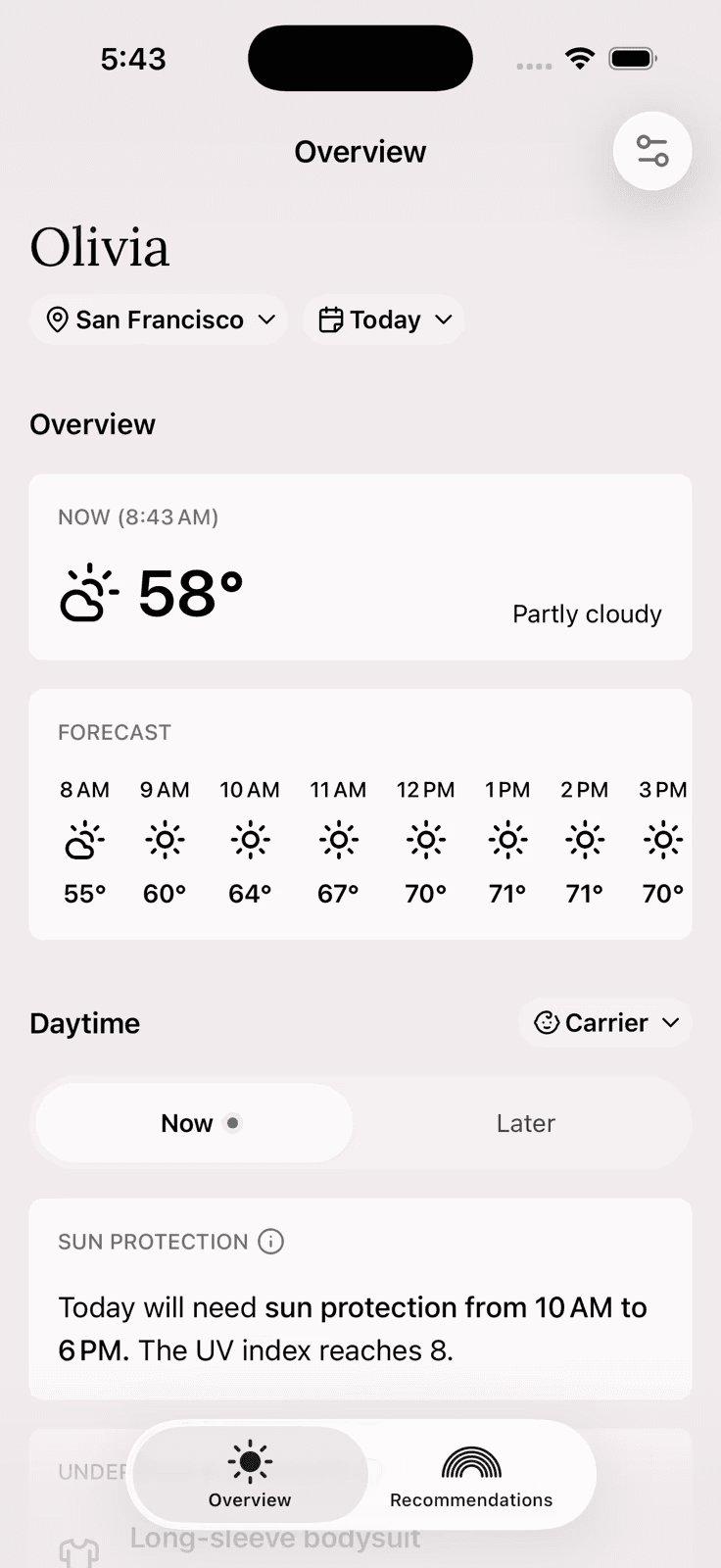
What should your baby wear today?
Wetterbaby checks the weather where you are and tells you exactly what your little one should wear. Hour by hour, from the first layer to sun protection.
Discover the app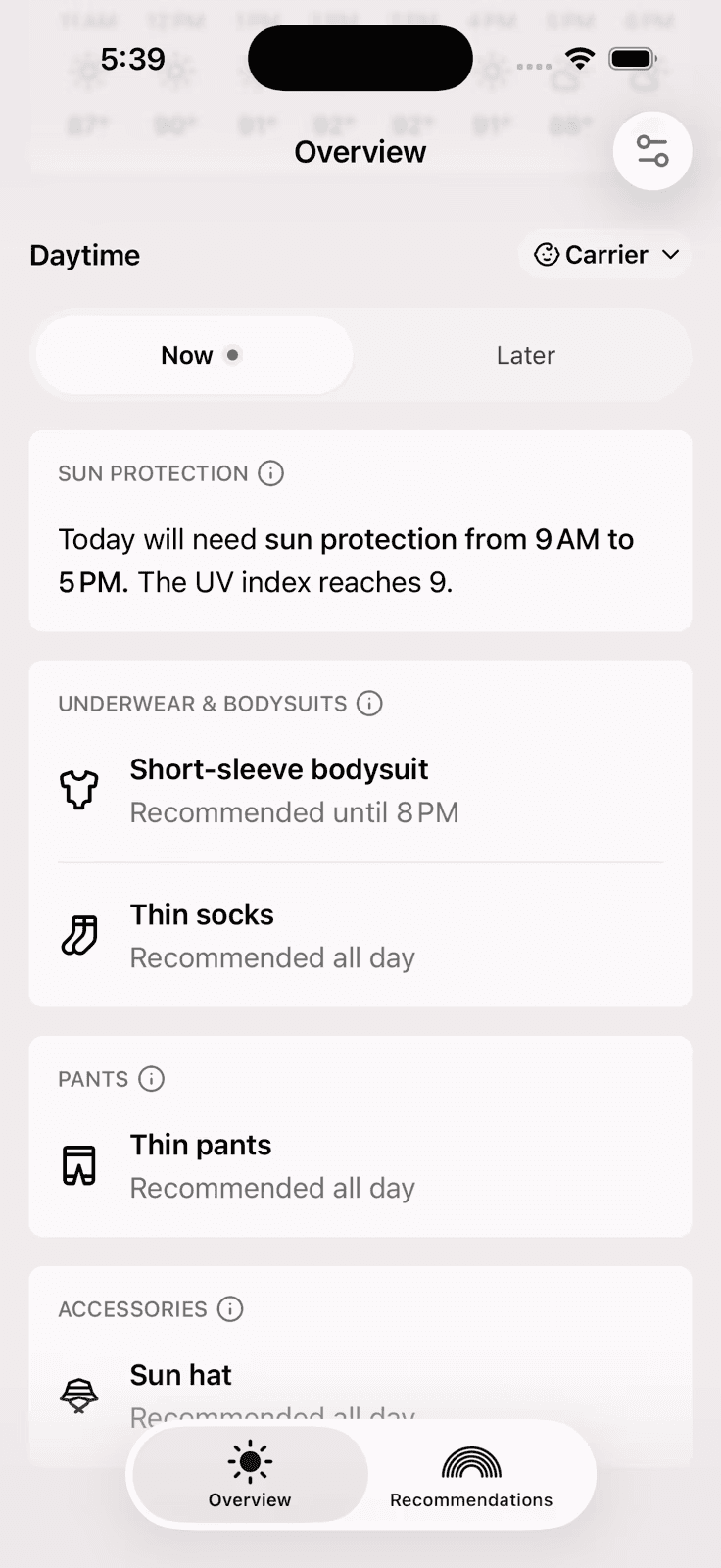
Dressing your baby 101
From layering to checking your baby's neck: quick answers to the questions that matter.
The basics
Several thin layers beat one thick one: you can adjust quickly on the go when the weather changes. A proven starting point: in the first months, one thin layer more than you're comfortable wearing yourself. Then watch your baby, because every child runs a little warmer or cooler.
More on layering in our blog articleThe most reliable check: place two fingers on the back of your baby's neck. Warm and dry means all is well. Sweaty means remove a layer; cool means add one. Good moments to check: after a walk, after a car ride, and before sleep.
Why checking the neck matters: our blog articleUsually not. Circulation to a baby's hands and feet is still developing, so cool extremities are normal. Whether your baby is actually cold is something the neck tells you, not the little hands.
Why infants get cold faster: more on the blogNatural, breathable fabrics like cotton, wool, or wool-silk blends. They wick moisture away and keep the temperature stable. Avoid synthetics directly on the skin, because heat builds up under them quickly.
Combining baby clothes: our guideLess than most lists claim: a few long-sleeve bodysuits, long-sleeve shirts, and pants, plus socks, a hat, and mittens. One outer layer per season is enough, plus a footmuff for the stroller. Buy a few pieces in two sizes rather than many in one, because babies grow fast.
All clothing pieces and starter essentials at a glanceIn the transitional seasons the weather often swings within a single day. Plan on several thin layers, one of which can come off or go on while you're out, and factor in the wind: a mild day with a stiff breeze feels considerably cooler to your baby than the thermometer suggests. A quick feel of the back of the neck tells you whether it fits.
Clothing tips for spring and fall: our guideOn the go: stroller, carrier & car
In the stroller your baby lies still and generates hardly any warmth of their own, so they need more insulation than you feel you need while walking. In cool weather, a blanket or footmuff (a cozy stroller bag, sometimes called a bunting bag in the US) makes a flexible outer layer. And in the sun: never drape a cloth over the stroller; heat builds up underneath. Use a stroller sunshade that lets air circulate.
Dressing your baby for the stroller: our guideIn the carrier your body heat warms your baby too, so count it as a full layer and dress your baby in one layer less than in the stroller. In winter, a carrier cover or carrier jacket is more practical than a thick snowsuit. Always make sure the mouth and nose stay clear.
Dressing your baby for the carrier: our guideThe most important rule is a safety rule: no thick jacket or padded snowsuit in the car seat. The harness can't sit snugly over bulky clothing and won't protect properly in a crash. Dress your baby in thin layers, buckle up, then lay a blanket over the harness. After the ride, as always: feel the back of the neck.
Why thick jackets are dangerous in the car seat: our guideFresh air is good for babies even in blustery weather; the outer layer is what matters. A wind- and water-resistant jacket or rain suit keeps the warmth of the layers underneath where it belongs. On the stroller, a rain cover protects your baby; make sure it has an opening for air circulation.
Rainy weather with baby: keeping your child dryNights & sleep
The safe setup: a bodysuit, pajamas, and a sleep sack (called a sleeping bag in the UK and Australia) on top. It can't slip over the face, which makes it a better choice than a blanket. How warm the bodysuit and sleep sack should be depends on room temperature alone.
Dressing your baby for the night: the full guide16 to 18 °C (61 to 64 °F) is ideal. That often feels chilly to adults, but it's the safest range for babies; overheating is a bigger risk during sleep than being slightly cold. A simple room thermometer takes the guesswork out of it. What counts is always the room temperature, not the weather outside.
How to create the ideal sleep environmentTOG measures how warm a sleep sack is: low ratings for warm rooms and summer, higher ratings for cool bedrooms. Sleep sacks sold in the US often carry no TOG rating; as a rough guide, a light muslin or cotton one is about 0.5 TOG and a warm quilted winter one 2.5 TOG. Two sleep sacks usually cover you at the start: a light one for warm nights and a warmer one for the rest of the year. Feeling the back of the neck tells you whether the combination works.
Baby sleep sack TOG guide: how warm is too warm?The two need different answers. A hat doesn't belong in bed: babies release heat through the head, and a hat traps it, which risks overheating. Thin socks are fine, though: in cooler rooms around 16 to 20 °C (61 to 68 °F) they help, in warm rooms you can leave them off. Feeling the back of the neck tells you whether the combination works; cool feet alone are normal at night.
Summer, heat & sun
Light and airy: a short-sleeved bodysuit or loose clothing made of cotton or muslin, plus a sun hat with a wide brim and neck protection. On sunny days, thin long-sleeved clothing often beats bare skin, because it blocks UV without adding warmth.
How to dress your baby on hot daysIn the first year, avoid direct sun as much as possible, especially around midday. Shade, airy clothing, and a sun hat are the most reliable protection. And be careful: UV is independent of temperature, and the UV index can be high even on cool or slightly overcast days.
Why babies need special sun protectionAs late and as sparingly as possible. In the first year, shade and clothing are the best protection; from around six months you can apply mineral sunscreen (SPF 50+) sparingly to exposed spots like the face and the backs of the hands. Sunscreen complements shade and clothing; it doesn't replace them.
Why babies need special sun protection: our guideTypical signs are a sweaty neck, flushed skin, fussing, or unusual drowsiness. If you spot them: out of the sun, remove a layer, and offer breast milk or formula. React early: babies handle heat far less well than adults.
Heat alert: keeping your baby cool on hot daysDown south, shade and light, airy clothing made of cotton or linen matter most. UV clothing with UPF 50+ protects at the beach and pool, and for sleep the same rule applies in a vacation rental: a sleep sack instead of a blanket on a firm mattress. Take the first days slowly, because your baby needs a little time to adjust to the warmth and humidity.
Vacation with baby: making the first trip relaxingWinter & cold
Think in layers: a bodysuit, a shirt and pants or a footed sleeper, and a warm snowsuit on top. Boiled wool, for example, keeps babies warm without overheating. Add a hat and mittens, since babies lose a lot of heat through the head. Clothing shouldn't sit too tight: small air pockets between the layers insulate best.
Boiled wool, softshell, or rain suit: choosing the right snowsuitYes. Well bundled up, there's nothing wrong with a walk even in freezing weather. Keep the rounds shorter and glance at your baby's face now and then: rosy cheeks are fine, pale skin means head home. In severe frost and icy wind, a short round is enough for newborns.
Outside with baby in any weather: yes or no?Loose scarves can tighten or slip over the face, a real safety risk. Safer options are a balaclava-style hat that warms the neck and ears too, or a bandana bib that closes with a snap. In the first months, no extra neckwear is usually needed if the jacket or snowsuit closes high enough.
Protecting your baby from the cold: our guideWarning signs
When pale, mottled, or bluish skin comes on top of the cool extremities, or your baby is unusually listless or refusing to feed. At that point, more clothing isn't the answer: warm your baby against your body and seek medical advice if in doubt.
Why infants get cold faster: more on the blogNo warmer than usual: trapped heat is the bigger risk with a fever. Choose light, breathable clothing and change sweaty clothes promptly. If the fever climbs or your baby seems apathetic, see a doctor.
Dressing your baby with a fever: what actually helpsOverheating. Babies can't regulate their body temperature well yet, and overheating is a known risk factor for sudden infant death syndrome (SIDS), hence the cool sleeping room, the sleep sack instead of a blanket, and one layer less when in doubt. With layering and a quick feel of the neck, you're on the safe side.
Safe sleep: the ideal sleep environmentLooking for more tips? Check out our blog.
Perfect clothing tips for every weather
Download Wetterbaby today and get personalized clothing recommendations for your baby — powered by real-time weather data. Simple, quick, reliable.





– Maya, 31